
From a book titled "What Will Become of This Child?!", you expect stories about some clumsy schoolboy. Most likely in the first person. And hardly anything innovative. The author's name, Paweł Beręsewicz, suggests that it takes place in Russia, and that you are about to encounter yet another imitation of Dragunsky.
But that is a misconception, it is not like that at all!
First of all, this is a translation from Polish, and it is in no way similar to "Deniska's Stories" or anything of the sort. Secondly, this isn't about one child—it’s about a series of troublemakers taking turns: first our contemporary, then his dad, grandfather, great-grandfather, great-great-grandfather, and so on... Eight generations of one family! And, of course, as the eras change, so do the mischiefs. For example, a modern child accidentally ruins his dad’s mobile phone; while the next one tries to color in a black-and-white television with paint. His predecessor rather clumsily organizes aerial photography using a "Leica" camera; while the next oldest toasts candy on an electric iron. Time passes—the pranks evolve. Would anyone today even think of luring an electric current out of a lampshade using a sausage threaded onto a metal knitting needle? But 150 years ago—yes! Or would a modern child play in the street with medical instruments from his doctor father’s bag? Back in 1860, there weren't many toys to speak of, so what else was a boy to do but serve as a doctor in a street army of his peers?
The book is short, a half-hour read. Short, but not one-time use—quite the contrary! You will want to reread it often because it is a wonderful example of children's humorous prose: comic situations told in precise and witty language. Here, for example, is a passage about a boy who decided to repaint the television:
"Yurik took his paints out of his desk, mixed various shades of gouache, and, whistling nonchalantly as a cover, headed to the kitchen.
- Where did we leave the funnel? - Yurik asked his dad, as if in passing.
Dad had a sandwich in his mouth, so he asked back rather indistinctly:
- Why do you need a funnel?
- To pour, - the boy answered briefly.
He didn't intend to explain any further, because he didn't want to spoil the surprise.
- Look in that drawer, - replied dad, and then for the rest of his life, he couldn't understand why he hadn't asked exactly why Yurik needed a funnel..."
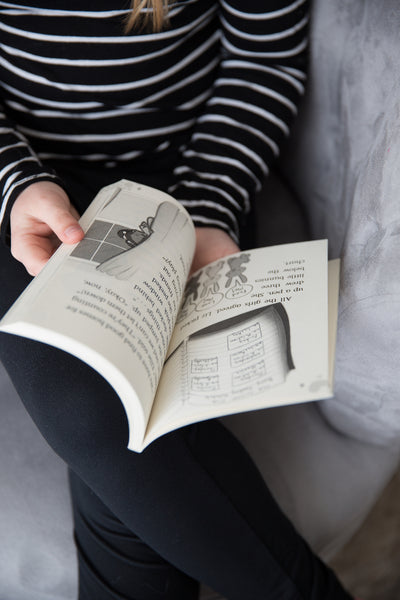
Adults will find it interesting to read these stories aloud, but the book is also suitable for independent reading; it features quite large print and many cool illustrations. They gently transport us from our own time back 200 years. A modern kitchen gives way to a typical 70s interior, through the post-war life of the mid-century we move smoothly to its beginning, where men sport elegant three-piece suits and boys wear sailor suits, and through a crowd of street urchins from the end of the 19th century, we end up in a printing house from the middle of the century before last.

Leave a comment